September 30, 2026 · 6 min
Liftgate delivery: what the liftgate is, when it is required, and what happens when nobody booked it
Four hundred and eighty searches a month for the accessorial, and three hundred and twenty more just asking what it means. The answer is a platform, a published limit, and a decision that belongs at booking rather than at the kerb.
Liftgate delivery is a term the freight industry uses as if everyone was born knowing it, and the search data says they were not: alongside the people looking for the service, a similar number are simply asking what it means. So here is the whole thing, the equipment, the situations that require it, and the expensive afternoon that follows when it was needed and nobody booked it.
What a liftgate is
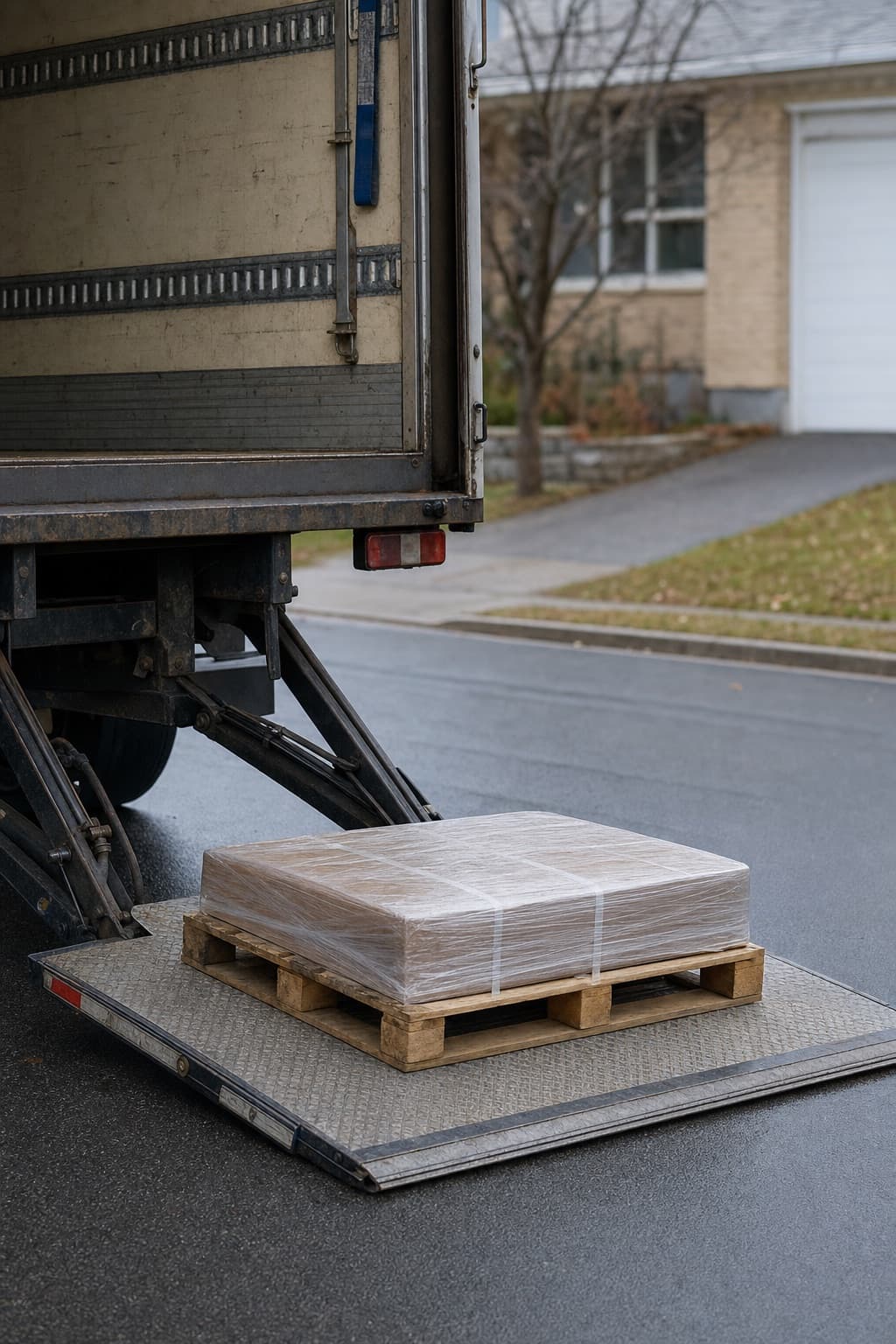
A liftgate is a powered platform fitted to the rear of a truck. It folds down level with the truck bed, takes a pallet rolled onto it with a pallet jack, and lowers it to the ground. A trailer floor sits at roughly the height of a loading dock, which is the whole reason docks are built at that height: the freight rolls straight across. Where there is no dock, the liftgate is the thing that bridges the drop. Not every truck has one. It is heavy, it costs the carrier capacity, and it is fitted to the local delivery vehicles that need it rather than to the fleet as a whole.
What liftgate delivery means on a quote
It means the carrier will send a vehicle equipped with a liftgate and the driver will lower the pallet to the ground behind the truck. That is the complete service. The pallet is not moved into the building, across the lot, over the kerb or up the driveway; that is inside delivery, a separate accessorial, and beyond that it is your equipment or your muscles. The line between the two is the edge of the platform, and the accessorial appears on the invoice as its own line, as described in what an LTL service includes.
When it is required
A liftgate is required at any delivery address where none of the following exists: a dock at trailer height, a forklift with someone to drive it during the delivery window, or a ramp a pallet jack can genuinely be used on. Residences are the obvious case, and a home business is a residence as far as the delivery is concerned. So are most small retail units, restaurants, offices, self-storage sites, farms, schools and construction sites. The question is not what kind of business receives the freight; it is whether there is a way to get a loaded pallet off a truck bed, and if the honest answer is no, the liftgate is not an upgrade, it is the only way the freight comes off.
When it is not, and when it cannot be
A dock, a forklift, or a receiver who will genuinely break the freight down piece by piece at the tailgate, which is rarely wise and often not permitted, because the driver is not there to unstack a pallet by hand. It is also not possible when the freight exceeds the platform. Liftgates have a rated capacity and a platform size that vary from truck to truck; the figure that matters is the carrier’s published limit for the equipment on your route, not a general number. A pallet heavier or longer than that limit cannot be liftgated regardless of what was booked, and the time to discover this is at quoting, when the answer is a different plan, rather than at the kerb, when the answer is a redelivery charge.
What happens when it is not booked
One of three things, none of them good. The vehicle on the route has no liftgate, the delivery fails, the freight goes back to the terminal, and a redelivery is scheduled with the charge that goes with it and another day of transit. Or the vehicle happens to have one, the driver uses it, and the accessorial is added to the invoice after the fact, so the quote you accepted is no longer the price you pay. Or somebody improvises: the driver tips the pallet, the receiver catches it, and a fully loaded pallet dropping from bed height is exactly how freight and people get hurt. A liftgate declared at booking is priced in and dispatched with the right truck. A liftgate discovered at delivery costs more in every version of the story.
The pickup end needs the same question
A liftgate at pickup is a separate accessorial from a liftgate at delivery, and needing both is normal for a shipment leaving a home or a small shop for another one. Everything above applies in reverse: no dock, no forklift, no ramp means the pallet cannot get up onto the truck any more than it could get down. The residential pickup page covers what else changes at an address without a dock, and it usually changes more than the liftgate alone.
Booking it well
Say what is physically at the address rather than what the business is called, because the tariff sorts addresses by what is there. Give the real weight of each pallet and its real dimensions, so the equipment sent can actually take it. Build the pallet so it survives being lowered and then dragged across whatever surface is behind the truck, which is what the pallet article is for. And if the freight is heavy or unusually large, say so in words at quoting; the alternatives, from terminal pickup to delivery at a nearby dock, are on the liftgate service page, and every one of them is cheaper than a failed delivery.
More advice
- October 7, 2026What a bill of lading actually is, and why it outranks your quote
- October 5, 2026Cheap LTL freight shipping: what honestly makes it cheap, and what a cheap quote is hiding
- October 2, 2026LTL freight brokers: what a broker does, what it does not, and what to check before you tender freight
Tell us what is at the address, not what it is called
No dock, no forklift, no ramp means a liftgate. Say so at quoting and it is priced in; discover it at delivery and everything costs more.
LTL Freight Match is an independent reference on less-than-truckload shipping for the people who buy it. It moves no freight, holds no brokerage authority and books nothing. It explains what decides a class, which accessorials turn a quote into a different invoice, and how to put competing quotes on the same footing.