Liftgate service: the accessorial people forget until the driver arrives
A liftgate is a powered platform on the back of the truck that lowers freight to the ground. If there is no dock and no forklift, it is not an upgrade, it is the only way the pallet comes off.
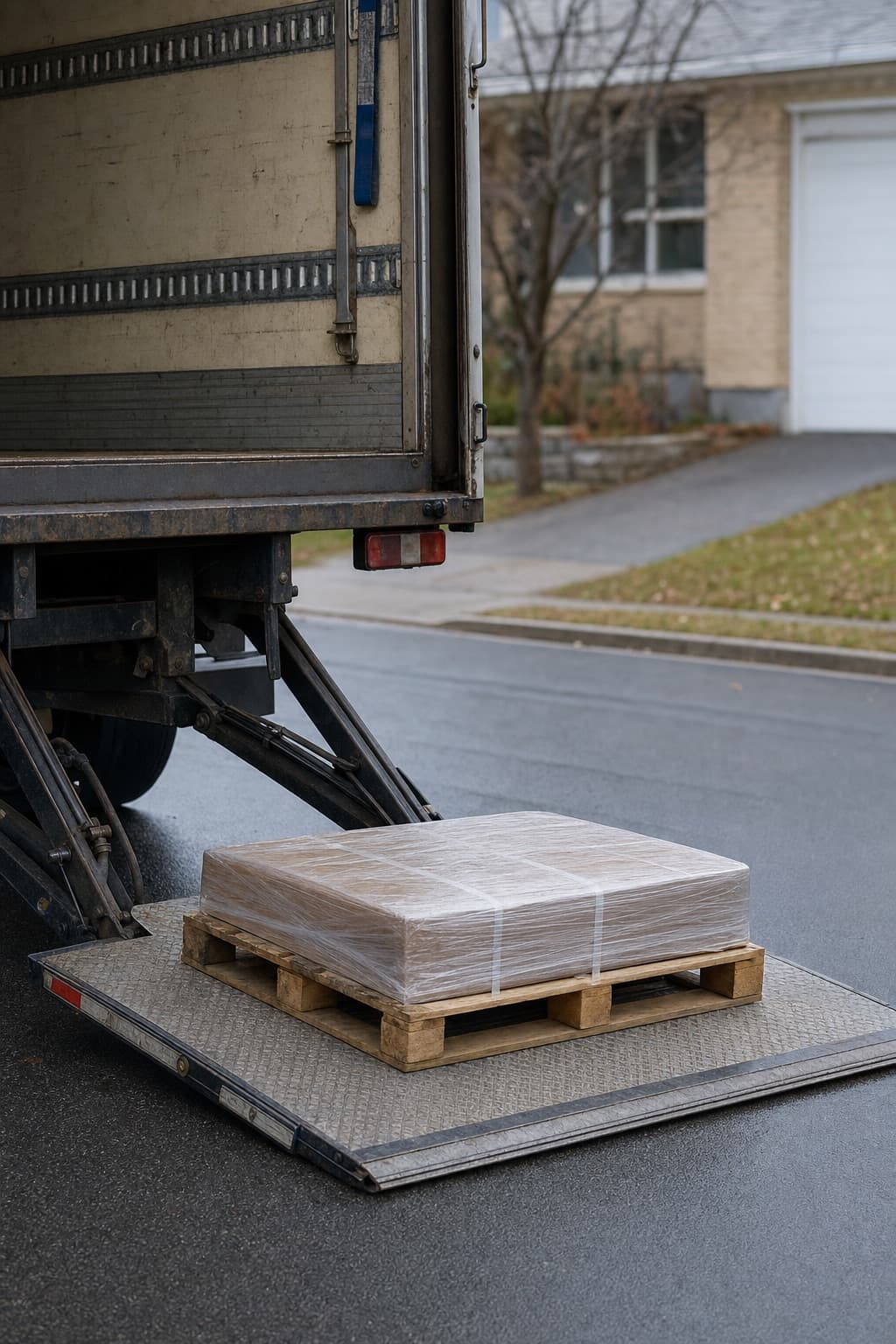
When a liftgate is required
A trailer floor sits at roughly dock height. Without a dock, without a forklift, and without equipment of your own, a loaded pallet has no way down. The driver is not going to unstack it by hand, and is generally not permitted to. What liftgate delivery means on a quote is explained separately.
In practice you need one at any location that has none of the following:
- A loading dock at trailer height.
- A forklift with an operator available during the delivery window.
- Ramp access that a pallet jack can actually be used on.
Residences, small retail units, restaurants, offices, self-storage, farms, construction sites and most trade counters fall into this category by default.
What a liftgate does not do
This is where expectations and reality separate most often. A liftgate lowers the pallet to ground level at the back of the truck. That is the whole of the service.
- It does not move the pallet into a building. That is inside delivery, a separate accessorial.
- It does not move the pallet across a car park, up a kerb, or over gravel. Ground level means the ground behind the truck.
- It does not unpack, unstack or position the freight.
- It does not remove packaging or debris.
Once the pallet is on the ground, moving it is the receiver's problem, and a fully loaded pallet on an uneven surface is a genuinely difficult object without equipment.
Physical limits worth checking
Liftgates have a rated capacity and a platform size, and both vary by truck. Very heavy pallets and oversized units can exceed one or both, in which case a liftgate delivery is not possible regardless of what was booked.
If a unit is heavy or unusually large, say so explicitly when requesting the liftgate. Discovering the limit at the kerb means the freight goes back to the terminal, and a redelivery charge starts.
Declare it at booking, not at the kerb
This is the practical point of the whole page. A liftgate declared at booking is priced into the quote and dispatched with the right truck. A liftgate discovered at delivery means one of three outcomes, all worse.
- The truck on the route has no liftgate, the delivery fails, and a redelivery is scheduled with the charge that goes with it.
- The truck has one, the accessorial is added to the invoice after the fact, and the price you were quoted is no longer the price you pay.
- Somebody improvises with the driver's help. That is not a service either party owes, and it is exactly the situation in which people and freight get hurt.
Pickup needs the same consideration. A liftgate at the pickup end is a separate accessorial from a liftgate at delivery, and needing both is normal for a residential-to-residential move.
The alternatives
- Terminal pickup. Collect the freight yourself from the carrier's terminal, where there is a forklift. Cheaper, but you need a vehicle and a way to load.
- Deliver to a business with a dock, a friendly supplier, a warehouse, a fulfilment partner, and move it the last mile yourself.
- Break the shipment down before it ships, so nothing on the truck needs equipment to move. Only viable for freight that is genuinely divisible.
Each of these is a real option and each has a cost in time. The wrong option is booking without a liftgate and hoping.
Frequently asked questions
Do I need a liftgate at pickup as well as delivery?
Only if the pickup location also lacks a dock and a forklift. They are separate charges and are declared separately.
Will the driver help me move the pallet inside?
No, unless inside delivery has been booked. It is not a matter of goodwill, it is outside what the driver is dispatched and insured to do.
Can I unload with my own equipment instead?
Yes, if you genuinely have a forklift and an operator available during the delivery window. Booking on that basis and then not having one is how failed deliveries happen.
How much does a liftgate cost?
It varies by carrier and lane, and we publish no rates. What is consistent is that declaring it upfront costs less than adding it after a failed delivery.
Related pages
- Freight class calculatorKnow your density, and the class it points to, before the dock measures it.
- Shipment descriptionStop comparing three quotes that describe three different shipments.
- Residential pickup and deliveryAvoid a residential surcharge added after the fact.
- LTL shipping costUnderstand a rate and anticipate adjustments.
- Pallet freight shippingPrepare pallets so they survive rehandling.
Declare the equipment you need
Liftgate at pickup, at delivery, inside delivery, appointment. Tick them in the form and they arrive priced rather than as a surprise.
LTL Freight Match is an independent reference on less-than-truckload shipping for the people who buy it. It moves no freight, holds no brokerage authority and books nothing. It explains what decides a class, which accessorials turn a quote into a different invoice, and how to put competing quotes on the same footing.