July 30, 2026 · 8 min
What LTL actually is, and why the cross-dock explains every surcharge
Twenty-seven thousand searches a month, and a competition index of 0.04. Almost nobody is answering this, so here it is properly.
Less-than-truckload shipping means your freight shares a trailer with other people’s freight. You pay for the space and weight you occupy rather than for a whole truck, and everything else about how LTL is priced and how it behaves follows from that one fact.
The journey, and why it is not a straight line
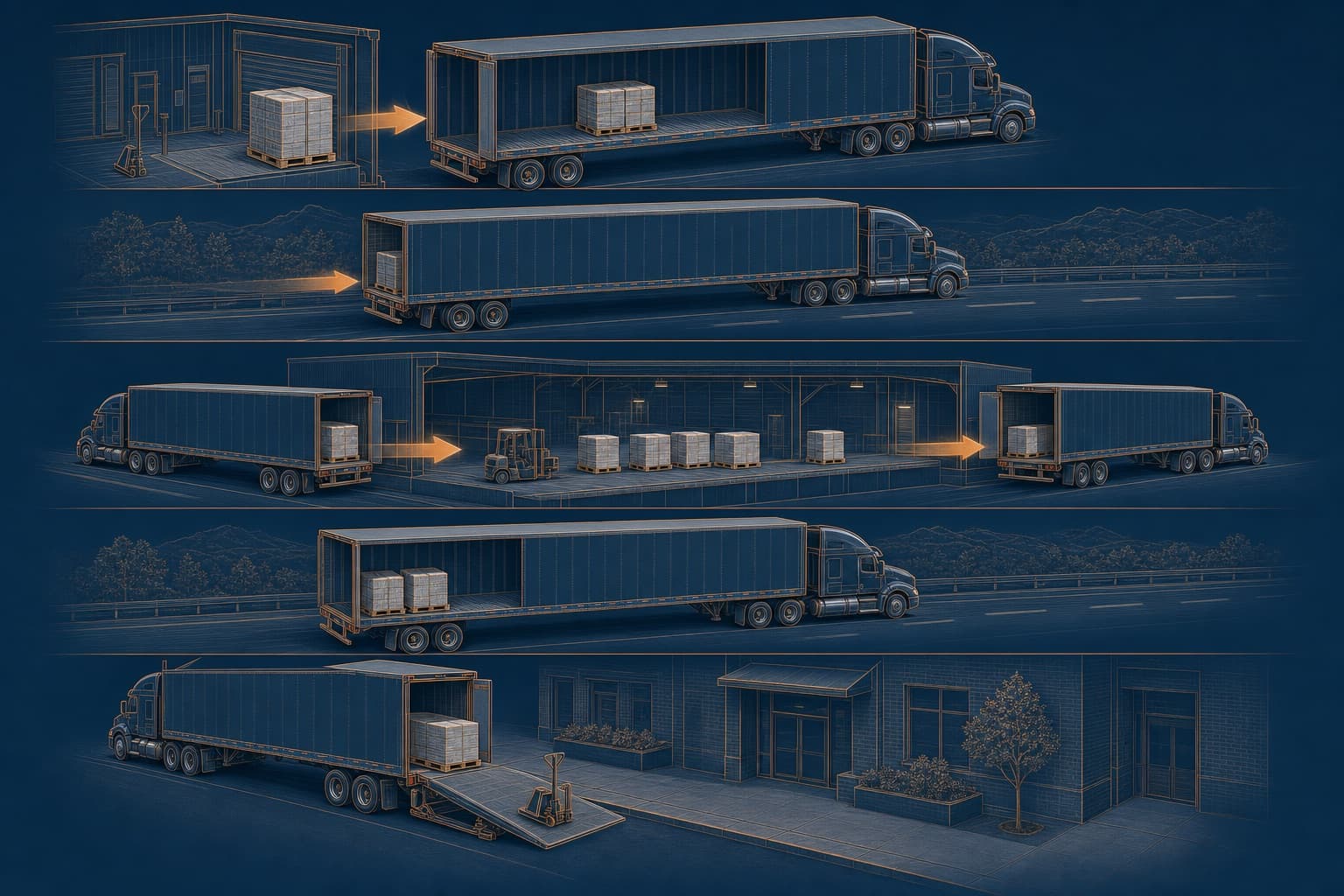
A pallet is collected on a local vehicle and taken to a terminal. There it is unloaded, re-sorted with freight going the same way, and loaded onto a linehaul trailer. It may pass through one or more further terminals, being handled each time, before a final local vehicle delivers it.
Between three and six handlings on a typical move. That is the reason LTL costs less than a dedicated truck, and it is also the reason a badly built pallet does not survive: full truckload freight gets loaded once and unloaded once, LTL gets moved by forklift five times.
What you are actually paying for
- Space and weight, expressed through freight class, which is a published classification by commodity rather than a formula you can run. See class and dimensions.
- The lane, because a carrier with a terminal at both ends prices very differently from one that has to interline your freight to another carrier.
- Handling, which is why stackable freight is cheaper than freight that must stay on the floor.
- Accessorials, the services beyond dock-to-dock: liftgate, residential, inside delivery, appointment, limited access, notification. These are where quotes and invoices most often diverge.
- Fuel, applied as a percentage that changes weekly.
The single most useful thing to understand
The carrier can re-rate your shipment after it is in their network. If the freight is measured or weighed and does not match the bill of lading, or if the class was wrong, the invoice is corrected. That is not a penalty, it is the system working as designed, and it is the reason accuracy at booking is worth more than shopping for the lowest quote.
Why that happens and how to avoid it is in the re-rating article.
When LTL is the wrong choice
Above roughly a half-trailer of freight the economics start to favour partial or full truckload, and the handling risk disappears with them. Genuinely fragile or irregular freight is frequently better on a dedicated vehicle even at a higher rate, because five forklift handlings is five opportunities.
The comparison is in LTL, partial or full.
What a broker does in this, said plainly
We hold federal brokerage authority and a surety bond, we have rates with multiple carriers, and we are a principal in the transaction rather than an introduction service. What that buys you is a single point of contact when a shipment goes wrong and someone whose job is the claim. What it costs you is a margin, and it is worth asking any broker whether their quote shows it. Ours does.
Have the shipment measured before it is quoted
A guessed dimension is the reason an invoice arrives higher than a quote.
LTL Freight Match is a licensed freight broker. It quotes, books and manages less-than-truckload shipments, arranges the carrier, and handles the classification, the accessorials and the claim if one is needed.